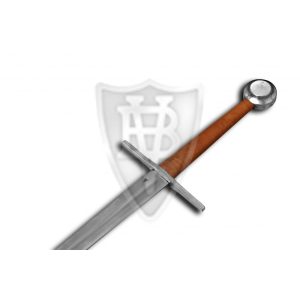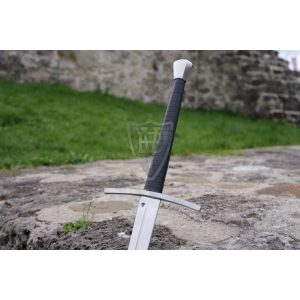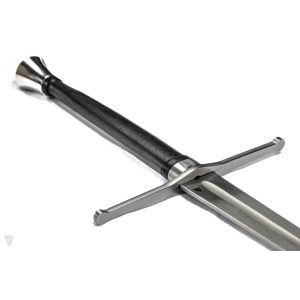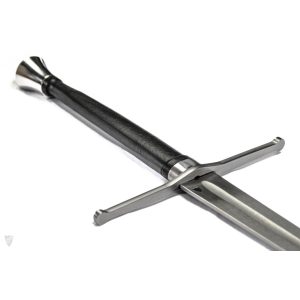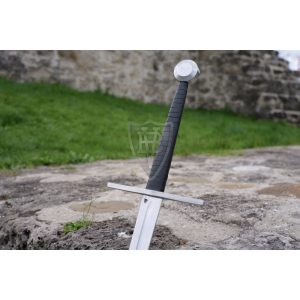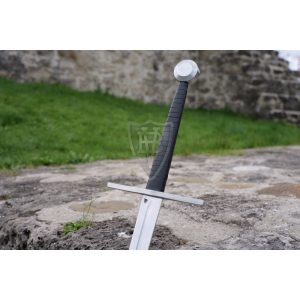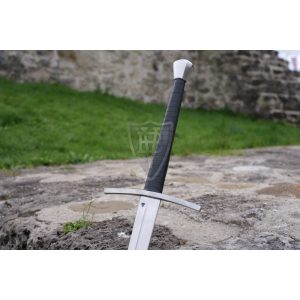
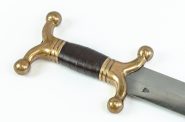
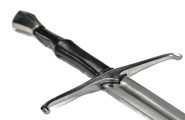
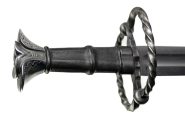
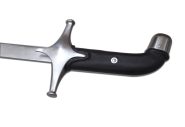
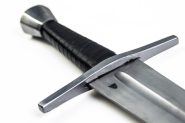
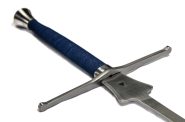
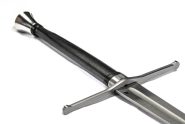
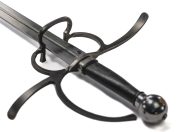
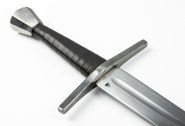
Trainingsword for HEMA sparring and for reenactment. This type of sword characterized as having a pear form pommel and slightly curved cross-guard.
Longswords are two-handed swords, that became popular in the 14th century, the Late Middle Ages. It appeared due to the development of armor. Since more developed armor like plate armour offered a better protection, shields were no longer obligatory. Instead, longer swords could be used due to the freed hand.
It was the weapon of nobles and knights. Typically used in conjunction with armor, simpler soldiers still stuck to the one-handed sword-shield combo. Later, in the Renaissance, they became more widespread, and they also started to be used for fencing. The first long sword fencing book was published in the 14th century by the famous Italian fencer Fiore dei Liberi. Johannes Liechtenauer started the basics of longsword fencing in German territories.
A feder sword, derived from the German "federschwert" meaning "feather sword," is a special-made longsword. for the study and practice of historical European martial arts (HEMA). Their blades are forged to be flexible, and more thin. Which means the sword is capable of the same moves as a regular longsword, but the blade itself has less mass, and thus a weaker impact. Meanwhile still retains most of its weight, so the practice you do is easily applicable on a full longsword. This feature allows practitioners to engage in spirited sparring matches and drills, with far fewer bruises.
Trainingsword for HEMA sparring and for reenactment. This type of sword characterized as having a pear form pommel and slightly curved cross-guard.
Trainingsword for HEMA sparring and for reenactment. The blade is made with fuller.
If You don't have the possibility, to train in a big hall, you need this swingsword.
The weight, POB is near the same, as by the HEMA longswords, it's ideal for exercise the fencing technics in a small room.
#trainathome
You can find information on disassembly and assembly here:
https://www.swordsviktor.com/disassembled_swords
HEMA sword for fencingtrainings, for technical fencing exercises.
The blade is narrow and stiff, with back-curved point.
Fix, riveted pommel.
Sharpening a sword blade before or after assembling the sword.
During sharpening, the blade loses its original thickness, making it more flexible and lighter, but also more fragile, of course.
The use of sharp swords is a training exercise that requires practice and knowledge, which must be exercised with extreme caution!
Damage and deflection of the swords are primarily due to cutting errors, so these damages are not warranty problems!
Long sword with channel blade developed for HEMA fencing.
The big advantage is that it fits our new type of 32 cm feder grip, so the blade can be replaced with a feder blade or an indoor blade.
With 1 handle, you can realize quite serious possibilities of variation.
The buttons on the cover swords are equally compatible with the grip.
The blade is hardened 51CrV4 steel, tip folded back.
You can find information on disassembly and assembly here:
https://www.swordsviktor.com/disassembled_swords
Long sword with channel blade developed for HEMA fencing.
The big advantage is that it fits our new type of 32 cm feder grip, so the blade can be replaced with a feder blade or an indoor blade.
With 1 handle, you can realize quite serious possibilities of variation.
The buttons on the cover swords are equally compatible with the grip.
The blade is hardened 51CrV4 steel, tip folded back.
You can find information on disassembly and assembly here:
https://www.swordsviktor.com/disassembled_swords
HEMA sword for fencingtrainings, for technical fencing exercises.
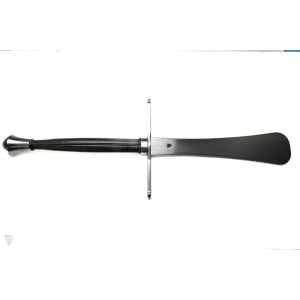
The blade is narrow and stiff, with spatulated point.
Fix, riveted pommel.
HEMA sword for fencingtrainings, for technical fencing exercises.
The blade is narrow and stiff, with back-curved point.
Fix, riveted pommel.
HEMA sword for fencingtrainings, for technical fencing exercises.
The blade is narrow and stiff, with back-curved point.
Fix, riveted pommel.